 Mishkan
Building a Jewish
future
online.
Mishkan gathers what a community needs to exist online into a single app: a currency of its own, private messaging, and a social network with no strangers and no algorithm.
Three services
Money, messaging and a social network — built for one community.
מ, one a day
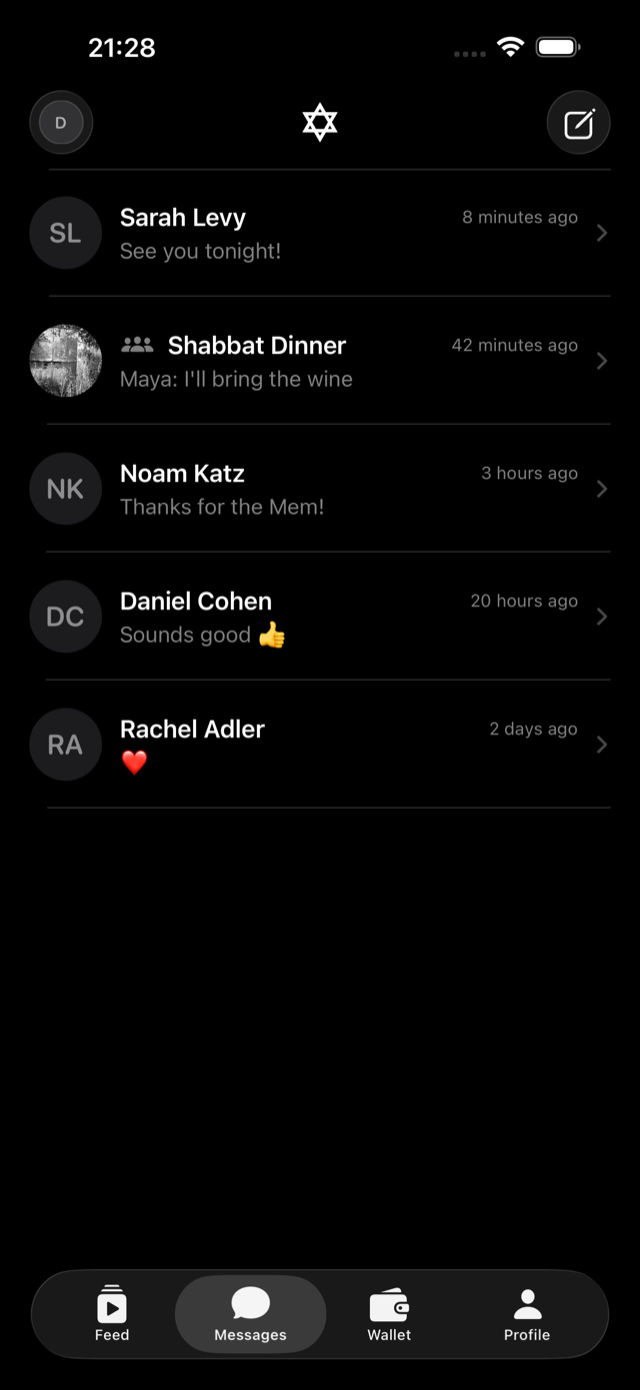
A currency the community issues to itself. It accrues by the second, it's sent by PIN, and it cannot be bought.
Private conversations
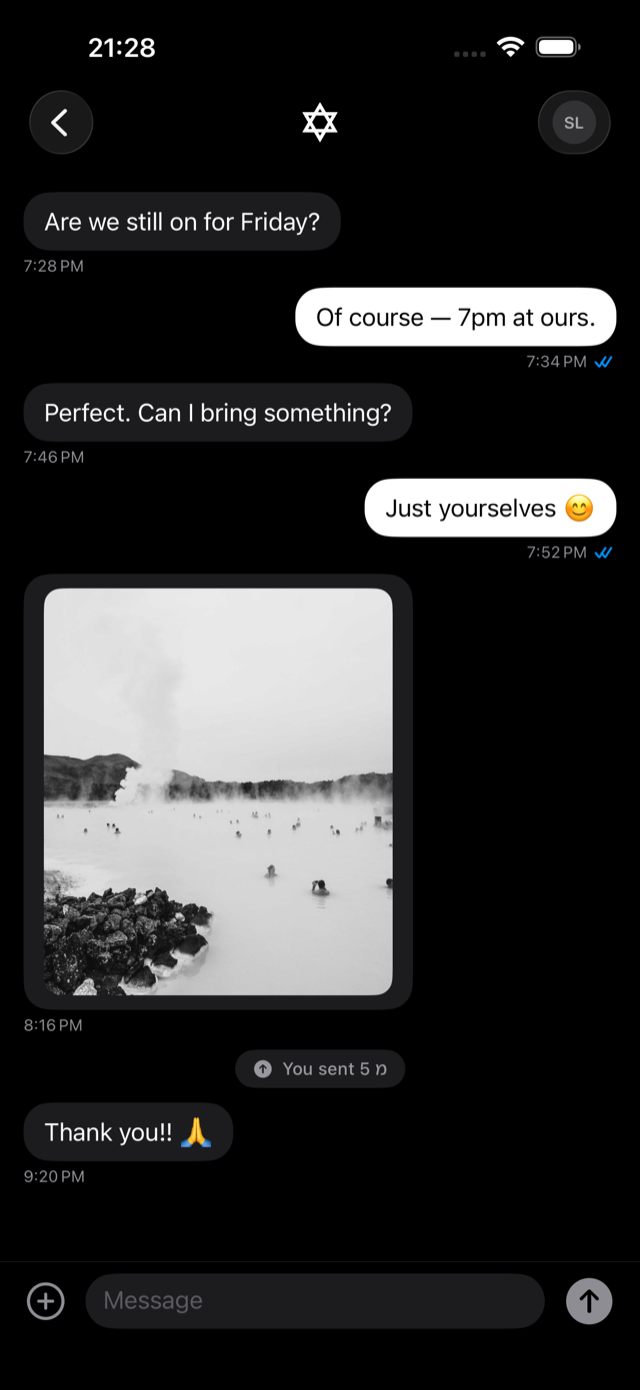
Direct and group chats, photos, videos, links, read receipts — and מ that travels inside the conversation.
Réels and Posts
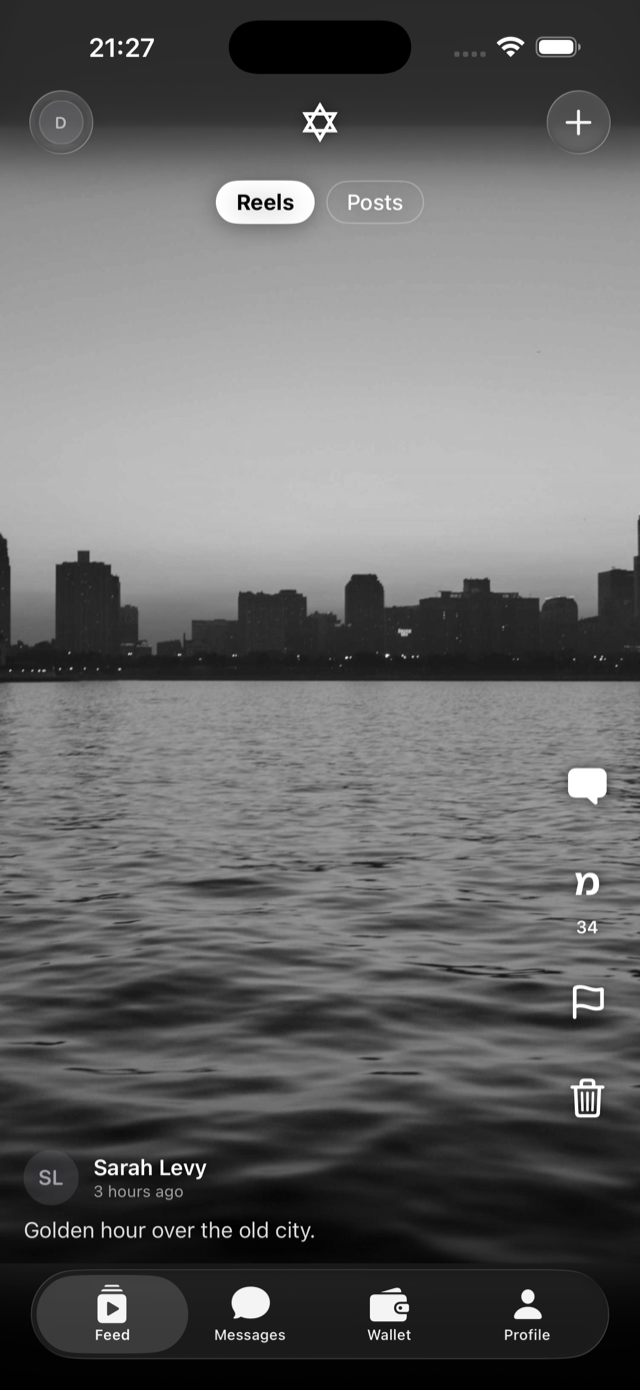
A chronological feed from your own community. Appreciation is paid in מ, and publishing is earned through verification.
01 / Money
מ — a currency the community mints for itself.
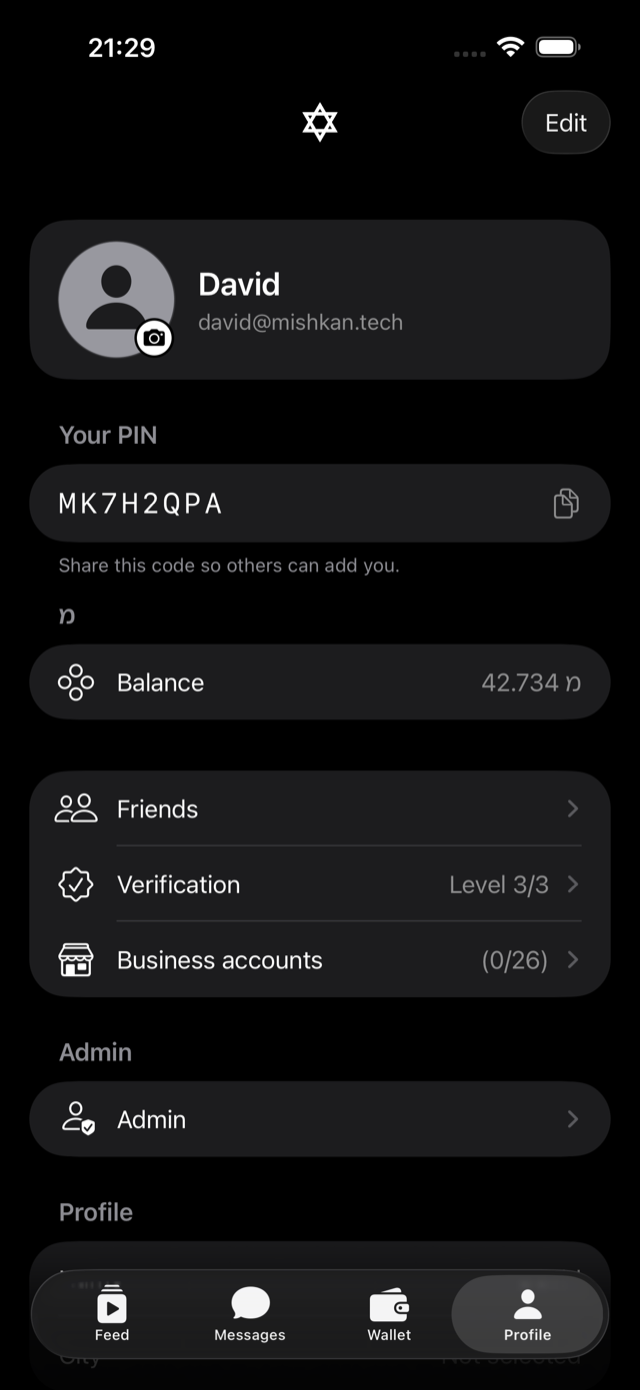
From the moment your account is verified, your balance grows by one מ a day — continuously, down to the second, on screen. It isn't bought, traded or backed by a bank: it is issued by belonging. Send it to a contact, to a post you liked, or to open a channel.
- One מ per day, automatically
- Your counter starts at verification and never stops. No purchase, no top-up, no subscription — the only way to hold מ is to be part of the community, or to be given some.
- Sent by PIN
- No account number, no phone number to hand out. Everyone has an eight-character PIN: enter it, and the מ arrives instantly.
- A ledger you can read
- Sent and received, to whom and when — the whole history sits in your wallet, in plain language, with a running balance.
- Money that circulates in the app
- Send מ from a conversation, on a post, or to enter a paid channel. It moves where the community already is.
- Chmita — every seven years, back to zero
- At the very end of the sabbatical year — 29 Elul 5789, which is 9 September 2029, at sunset in Jerusalem — every balance returns to zero, for everyone at the same instant, and the counter starts again from there. A balance can never fall below zero, so there is no debt to carry across: what the release lets go of is accumulated credit. Your history stays readable; only the balance starts over.
מ is earned, never sold. There is nothing to buy in Mishkan — and every seven years, everyone starts again from zero.
02 / Messaging
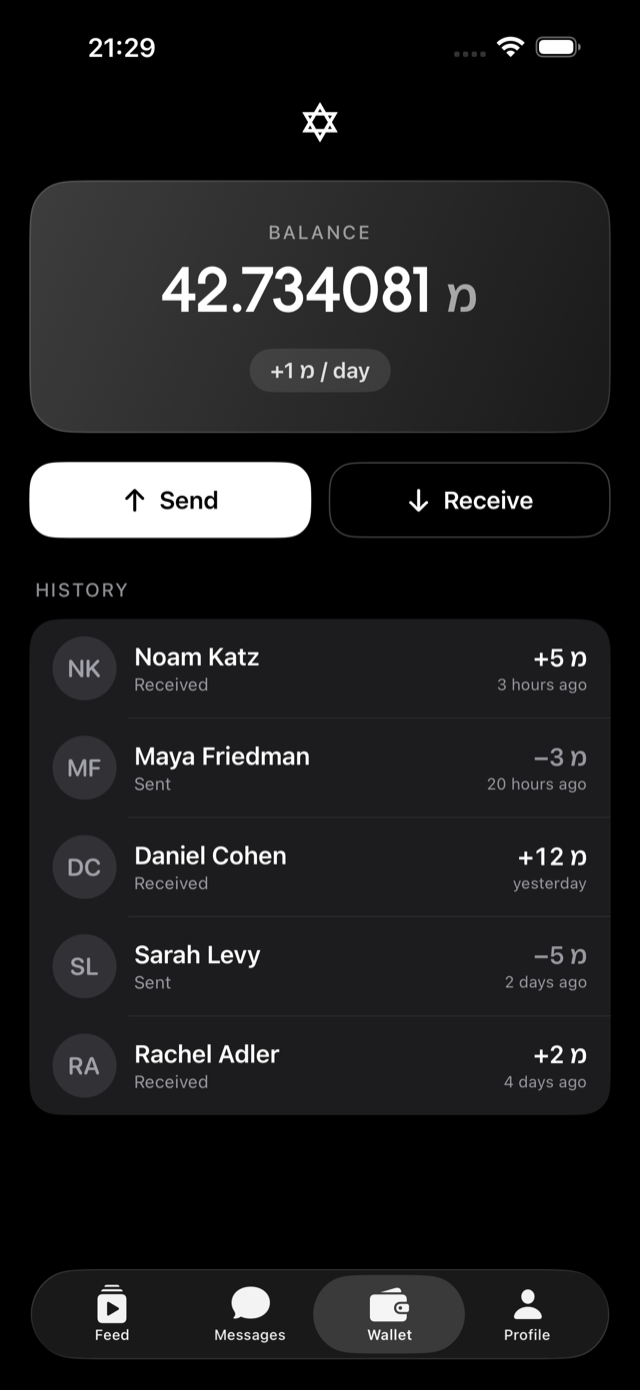
A messenger for the people you actually know.
Mishkan's messaging is a real messenger, sized for a community rather than a crowd: direct chats, group conversations, media, links and receipts — and nobody you haven't added yourself.
- Direct and group
- Write to one person or to a whole Shabbat table. A group is a conversation with a name and a picture, and the same tools as any other.
- Photos, videos and links
- Send media straight into the thread; links render with a preview instead of a raw URL.
- Per-person read receipts
- In a group you see who has actually caught up — not just that “someone” read it.
- מ inside the conversation
- Send מ without leaving the chat: it appears in the thread like any other message, and lands in the wallet immediately.
You decide who reaches you: the people you already talk to, whoever you gave your PIN to, and anyone answering something you published. Blocking cuts contact both ways.
New in Mem
Pay continuously. Subscribe to a channel with a share of your day.
A Mem balance already grows by the second — one Mem a day, from the moment your phone is verified. Now that same clock can pay: choose someone, or a business, and pour so many Mem a day into their wallet, for as long as you like. Nothing is taken at once, no date to remember. Your balance simply moves at its new pace, and theirs too. And a channel can ask for exactly that: a rate per day to stay in.
Level 2 (phone verified) is required to open a continuous payment, because it is your counter that backs it. A channel keeps its one-off entry price too, if it has one.
- 01
Once, or every day
In Send, switch to "Every day". The amount becomes a rate, and the button opens the payment instead of moving Mem once.
- 02
Subscribe to a channel
A channel owner sets a rate per day. Joining opens the payment to them; you belong for as long as it runs.
- 03
Stop when you like
From the wallet, either side can end it at any moment. Stopping a subscription leaves the channel. What already flowed stays.
- A share of your day, never a debt
- Everything you pour out, put together, can never exceed your own daily Mem. A subscription is a slice of your time — a balance never sinks below zero through it.
- Nothing is charged, ever
- There is no monthly charge and no due date. The balance is recomputed from the rate and the time elapsed, the same way the daily counter is.
- The wallet shows the slope
- "+0.7 Mem a day": your counter, plus what comes in, minus what goes out. The parts are spelled out underneath, each running payment shows what it has poured so far, and a payment that ended stays in the history with its total.
- Businesses receive, people pay
- A business account can receive continuous payments into its own wallet, but only a person's counter can back one.
- Blocking cuts the flow
- Block someone and every payment between you stops that instant, both ways — and any subscription with it.
- Chmita, unchanged
- Every seven years all balances return to zero, on the same day for everyone. A running payment survives it: it is a rate, not a balance.
- Or ask for it
- The one who will receive can ask first: a contact, or anyone by PIN, for so many Mem a day. The request lands as a card in your conversation, where the other side accepts or declines, and its status stays readable there and in the wallet.
New in messaging
Introductions. One member, one day, then the queue moves on.
Ask for an introduction, and you are paired with the next member who asks — the third waits for the fourth, and so on. The two of you get a conversation open for twenty-four hours. No profile to browse, no swiping, no algorithm choosing for you: only the order in which people asked.
The queue is blind: it looks at nothing but who asked first. Two people who ask at the same second still make one pair, not two who wait for each other.
- 01
Ask
From the Messages tab: one tap, and you are in the queue. Withdraw whenever you like.
- 02
Wait
The next member who asks is paired with you. You are notified the moment it happens — you don't have to keep the app open.
- 03
A day together
The conversation is an ordinary Mishkan chat, with a countdown. After twenty-four hours it closes. Exchange PINs if you want to keep talking.
- Faces, not handles
- You see who you were paired with — name, photo and verification level — before you write a word. No anonymity: it is what invites abuse.
- Verified phone required
- Level 2 to ask. A chat with a stranger is the harassment vector of choice; a verified phone is what separates a member from an account made a minute ago.
- Not a contact
- Being paired doesn't make the other person reachable afterwards. When the day ends, so does the door — unless you chose to share your PIN.
- Kept, not deleted
- Mishkan keeps the thread. It leaves your list after a day and comes back, with everything you said, if the queue pairs you again — which can happen the very next day.
- A block ends it at once
- Block the person and the conversation closes for both sides on the spot. The queue never pairs two people who blocked each other.
Also in the app
A Jewish directory, France and the United States, that works with no network.
8 149 addresses ship inside the app: 4 100 in France, 4 049 in the United States — kosher restaurants and supermarkets, synagogues, mikvehs, schools, butchers, cemeteries. The base sits on your device, so a search answers at once, even with no signal. And it doesn't stand still: the members who actually go there keep it right.
- Embedded, therefore offline
- The records travel with the app. Search, filters and distances are computed on your phone: no network call, nothing asked of a server, nothing that says what you were looking for.
- Nearest first
- Turn on location and the list orders itself by distance, each place showing its own. Or filter: kosher only, by category — restaurant, synagogue, mikveh — or by département.
- Corrected by the people who go there
- From level 2: report a closure, a move, a wrong number or wrong opening hours, recommend a place, add a photo — three per member, stripped of their EXIF before anyone sees them.
- Kosher supervision is never a vote
- Kosher status comes from the body that grants it: the Consistoire and the Beth Din de Paris in France; the OU, OK Kosher and the vaadim of Queens, Miami and Los Angeles in the United States. A member's report raises a human check and changes nothing by itself, however many are filed.
- Proposed, claimed, kept up
- At level 3 you can propose a place the collection never found — an admin reviews it before anyone sees it. At level 4, a business account claims its own record and keeps it current; the name and the kosher status stay out of its hands.
Corrections don't stop with us: they are exported back to the collection that feeds the base, so the next pass keeps what members reported instead of overwriting it.
AI, with your own keys
Bring your own AI. Mishkan never sees the key.
Mishkan has an AI chat and a Studio that writes short reels for you. They run on the providers you choose, with your own API keys — stored encrypted on your device and sent straight from the app to the provider. No subscription through us, no markup, and nothing goes through our servers.
In the app: Profile → AI keys. Each provider links to its own console. A key is a billing credential: if you think one has leaked, revoke it at the provider.
Supported providers
- Get a key
Anthropic
Claude models, for the chat and the Studio.
- Get a key
OpenAI
GPT models, for the chat and the Studio.
- Get a key
Google AI Studio
Gemini models, for the chat and the Studio.
- Get a key
ElevenLabs
Voice-overs for Studio reels, in the voices on your account.
On the device
Apple Intelligence or Gemini Nano: no key, no network — neither the question nor the answer leaves the phone.
- On the device, nowhere else
- In the Keychain on iPhone and Mac, in hardware-backed encrypted storage on Android. Never synced, never backed up, never sent to Mishkan — enter it on each device.
- Straight to the provider
- Requests leave your phone for Anthropic, OpenAI, Google or ElevenLabs directly. You pay the provider, at the provider's price.
- Only the last four characters
- Once saved, a key is never shown again in full — just enough to recognise it, not enough to read it over your shoulder.
- Conversations stay local
- AI chat history lives on the device, like the keys. One button erases it.
- The Studio
- Describe a reel, a model writes it, the app encodes it, and it lands ready to publish. Add a voice-over and ElevenLabs reads it over the video.
- A wrong key caught early
- Each field checks the key's prefix, so a key pasted in the wrong place is flagged at once — not after a cryptic error.
Security isn't a feature here. It's the ground floor.
Mishkan is built for Jewish communities, which means it is built to be attacked. Everything below exists for that reason.
- Four levels of verification
- Email, then phone, then a photo of your mezuzah approved by a human, then formal verification. Level 2 activates your מ counter; level 3 unlocks publishing.
- Nothing public to scrape
- No member directory, no username search, no profile to crawl. You are reachable only where you chose to be: through your PIN, through the people you added, or through what you published yourself.
- Blocking that actually blocks
- Block someone and it holds in both directions: no message, no מ, no group invite, and their posts leave your feed.
- Business accounts
- Up to 26 sub-accounts under one member: an alternate identity to post and write with, while the מ stays with the owner.
- Three languages, natively
- English, Français and עברית — right-to-left included — everywhere in the app and on this page.
“Mishkan” — מִשְׁכָּן — the dwelling place. A small, portable home for community, wherever you happen to live.
Built with care, in three languages: English, Français, עברית.
Bring your community in.
Mishkan is free, on iPhone, iPad, Mac and Android, and already in three languages. Download it, verify yourself, share your PIN.
03 / Social network
A feed that belongs to the community.
Two feeds in one tab: Réels — full-screen video — and Posts, short text with links. Chronological, from your community, with no advertising and no recommendation engine deciding what matters.
No ads. No sponsored posts. Nothing to promote.